
Facial Balancing in New Berlin, WI Proportion, Not Just Volume
Most aesthetic treatment chases one feature at a time — a line here, a lip there. Facial balancing starts from the opposite direction: it looks at how the whole face relates to itself, then decides what actually needs treating to bring it into proportion. Sometimes the answer isn't the thing you came in about. A chin that needs projection can be why a jawline reads soft. A midface that lost volume can be why the lower face looks heavy. Performed by our RN injectors at A-Class Aesthetics in New Berlin — minutes from Milwaukee, Brookfield, and Waukesha.
Restoring What Changed
Volume loss doesn't happen evenly. As collagen and fat pads diminish, the midface descends and the lower face takes on weight it didn't used to carry. Rebuilding support where it was lost lifts the whole structure rather than filling in what shows.
Enhancing What's There
Nothing has been lost — the proportions were simply always a little uneven. A shorter chin, a flatter jaw angle, a lower third that doesn't quite match the upper. Small structural additions in the right places shift the whole face toward balance.
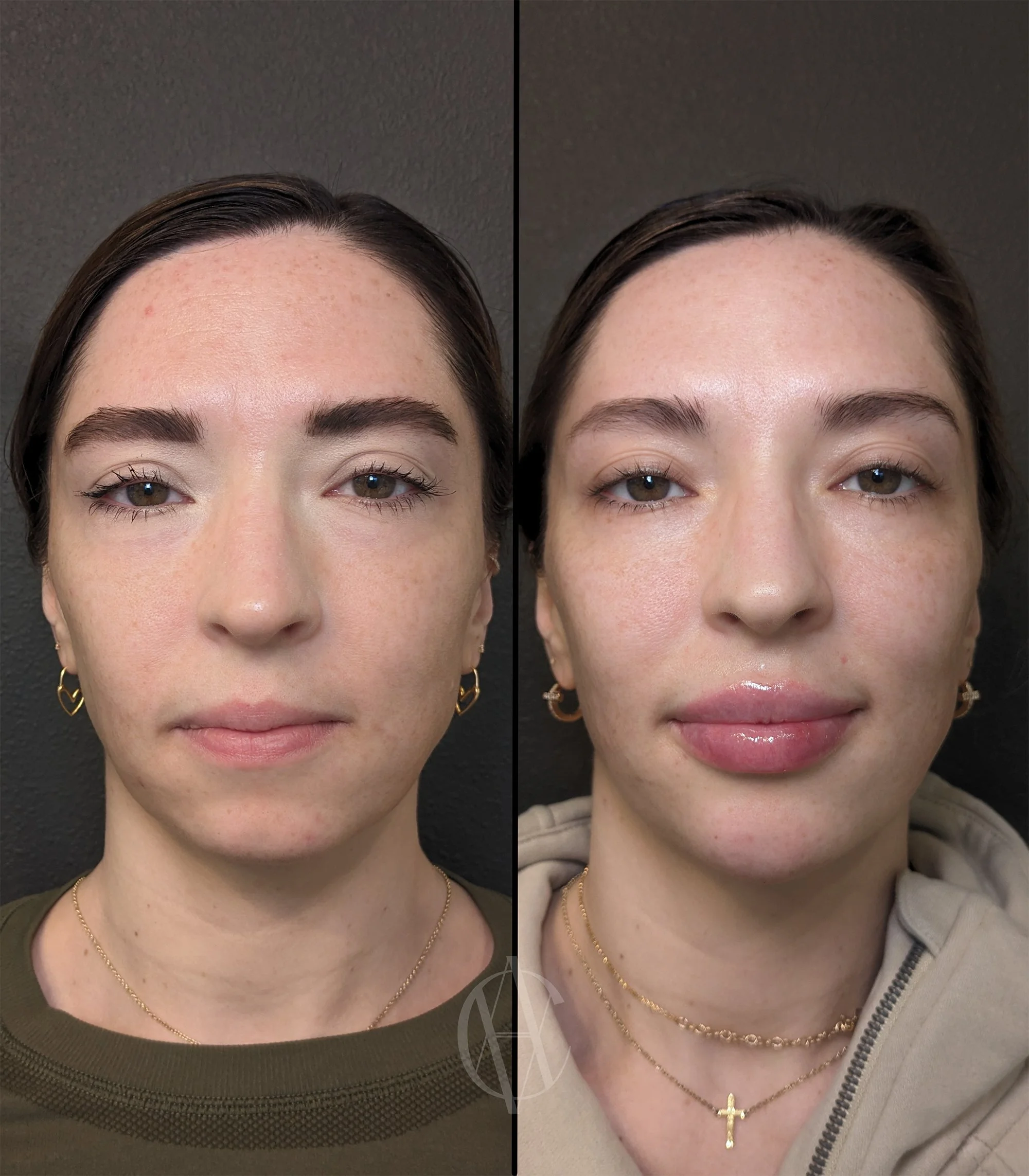
Facial balancing — front view. Lip, cheek, and chin filler in a single treatment plan. Proportional balance across all three zones. A-Class Aesthetics Med Spa, New Berlin, WI.
Only
Dr. Dave Christianson
Around Priorities
Near Milwaukee
What Is Facial Balancing? Treating Relationships, Not Features
Your face isn't read as a list of separate features. It's read as a set of relationships — how the midface sits above the jaw, how the chin relates to the lips, whether the lower third matches the upper. When one of those relationships is off, the eye registers it as something being wrong without identifying what.
That's why treating a single feature in isolation sometimes disappoints. Adding volume to a lip that was never the problem doesn't fix a lower third that's out of proportion — it can make the imbalance more obvious.
Facial balancing works the other way around. We look at the whole structure first, identify which relationship is actually driving what's bothering you, and treat that. Frequently the answer is upstream of where you were looking.
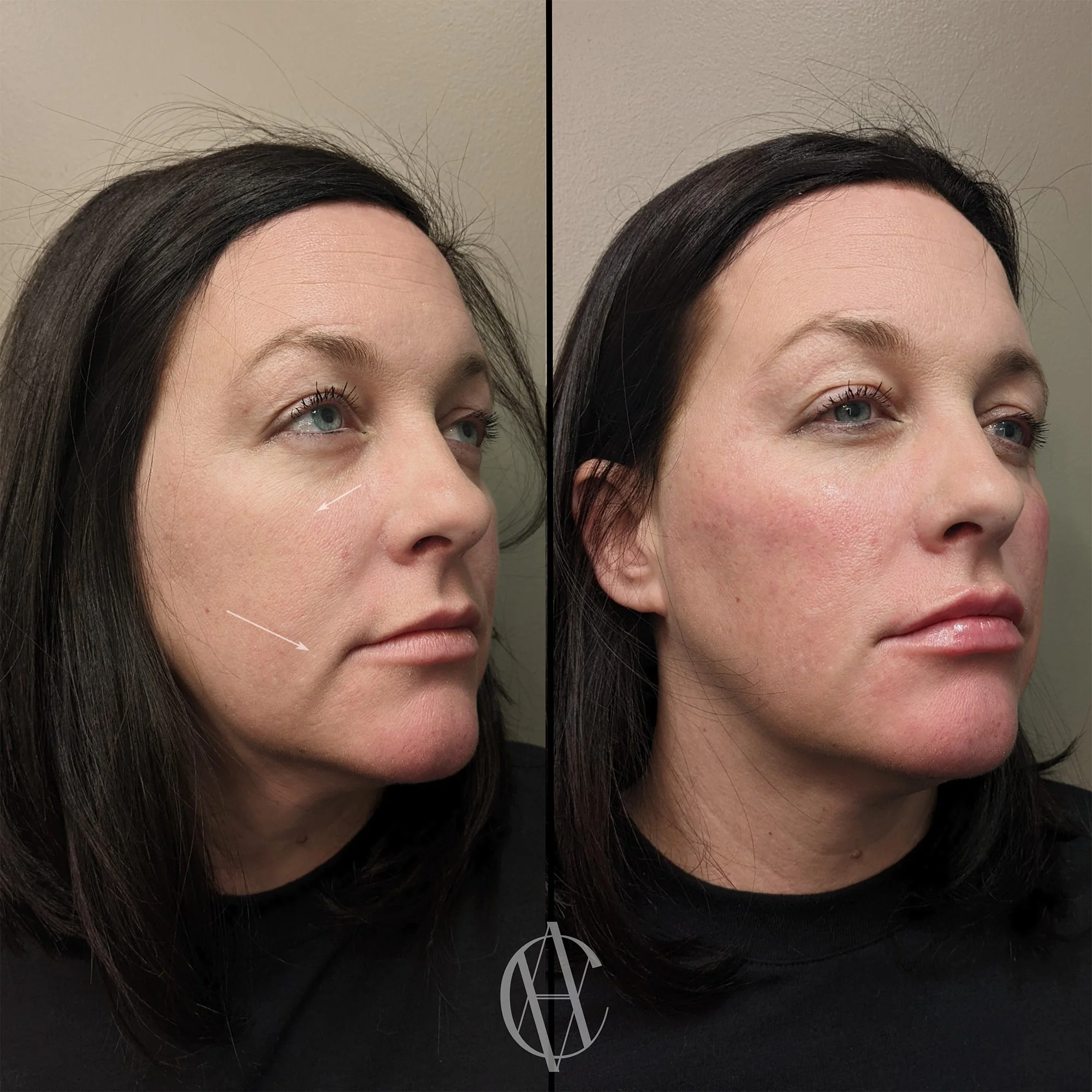
The principle, in one photo. Arrows mark the two areas treated: midface cheek support above, marionette line softening below. The lines below softened because the structure above them was rebuilt — not because they were filled. Individual results vary.
Upper Third
Forehead, brows, and the eye area. Brow position sets the tone for the entire face — a heavy or flat brow reads as tired regardless of what's happening below it. Usually neurotoxin territory, occasionally filler for temple hollowing.
Middle Third
Cheeks, midface, and undereye. This is the zone that quietly drives everything else. When midface support diminishes, tissue descends — which is why nasolabial folds deepen and the lower face starts looking heavier than it is.
Lower Third
Lips, chin, jawline, and the jaw angle. Proportion matters more than volume here. A chin that lacks projection makes a jawline read as soft; lips look balanced or unbalanced depending on the chin behind them.
Facial balancing is not a package, and it's not a reason to treat more areas. Some patients leave a consultation with a plan for three zones over six months. Plenty leave with one recommendation and a note that the rest doesn't need touching.
The value isn't in doing more — it's in doing the right thing in the right place. If what's bothering you can be solved with a single treatment, we'll tell you that rather than building a plan around it.
Facial Balancing Before & After Four Cases, Four Different Answers
No two balancing plans look alike — which is the point. Below, every case lists exactly which tool did which part of the work, because a result that combines filler, biostimulator, and neurotoxin shouldn't be presented as though any one of them did it alone.
Rebuilding Support, Not Filling Lines
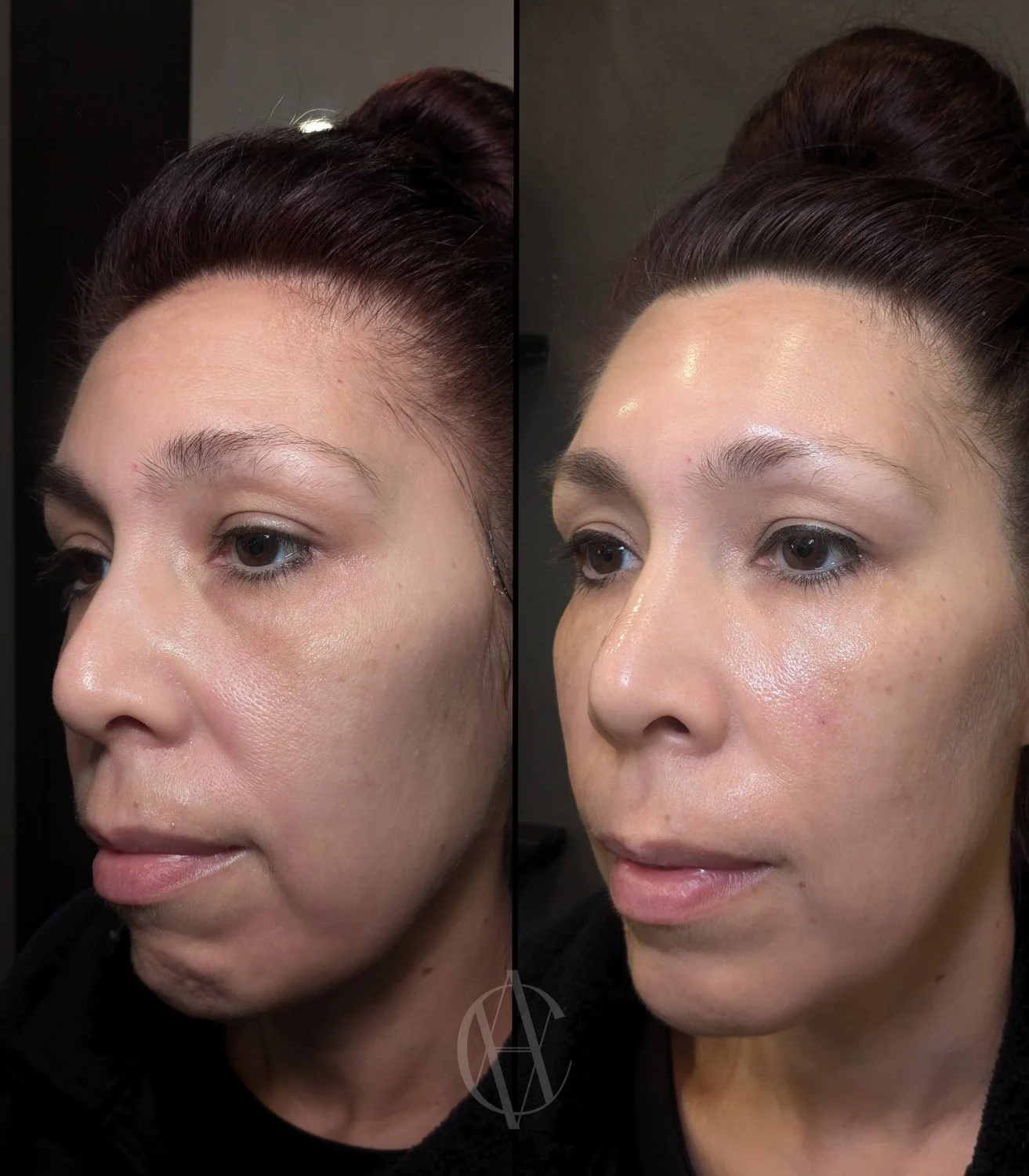
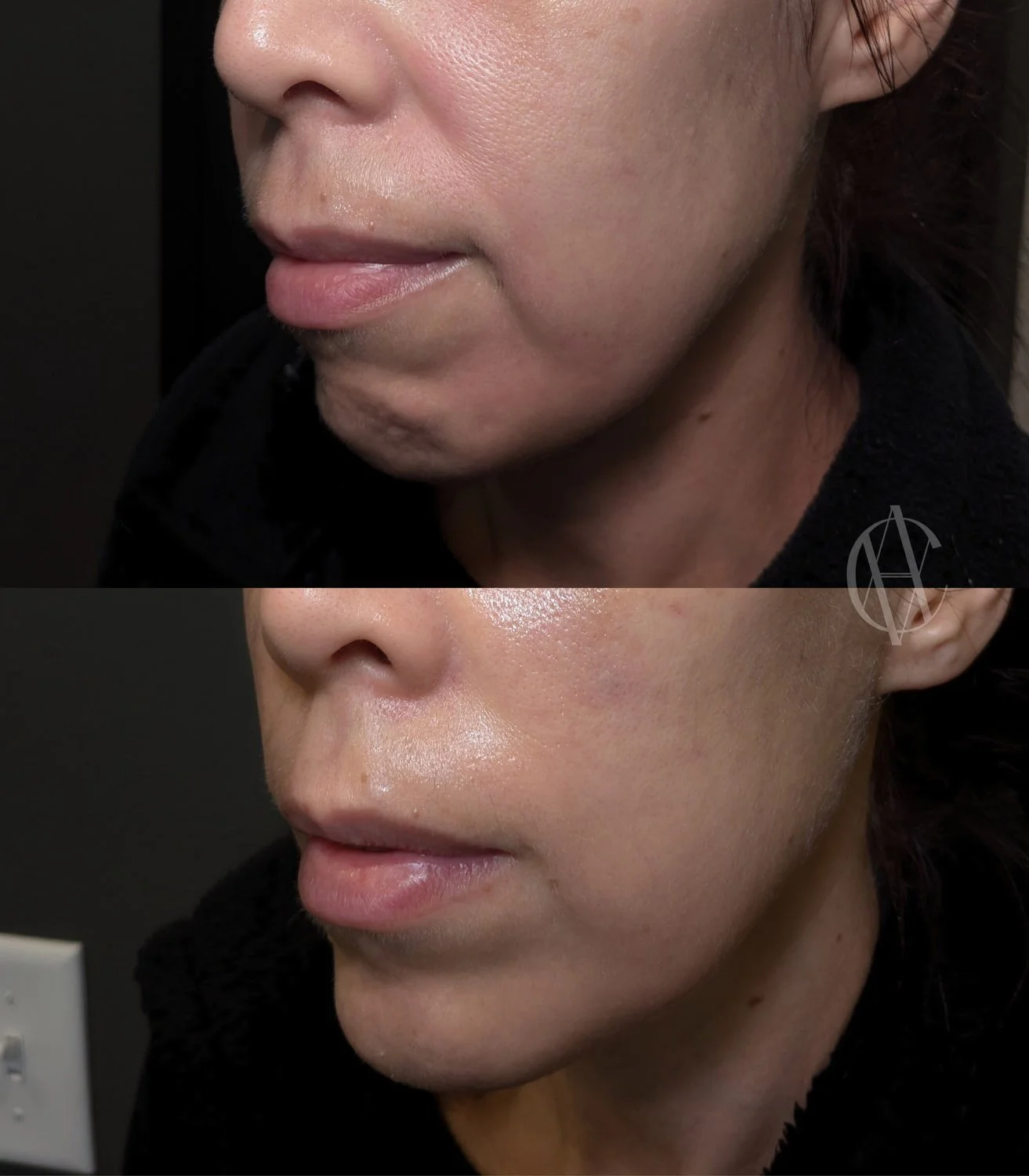
This patient came in with volume loss driving the whole picture. The midface had descended, which made the lower face read heavier and the undereye hollow deeper. Filling the lines directly would have chased symptoms.
Instead the plan rebuilt structure from the top down — collagen restoration across the midface, targeted volume at the cheeks, and neurotoxin to release the chin tension that was adding strain to the lower third. The midface lifts rather than falls, and everything below it settles accordingly.
Three Zones, One Plan
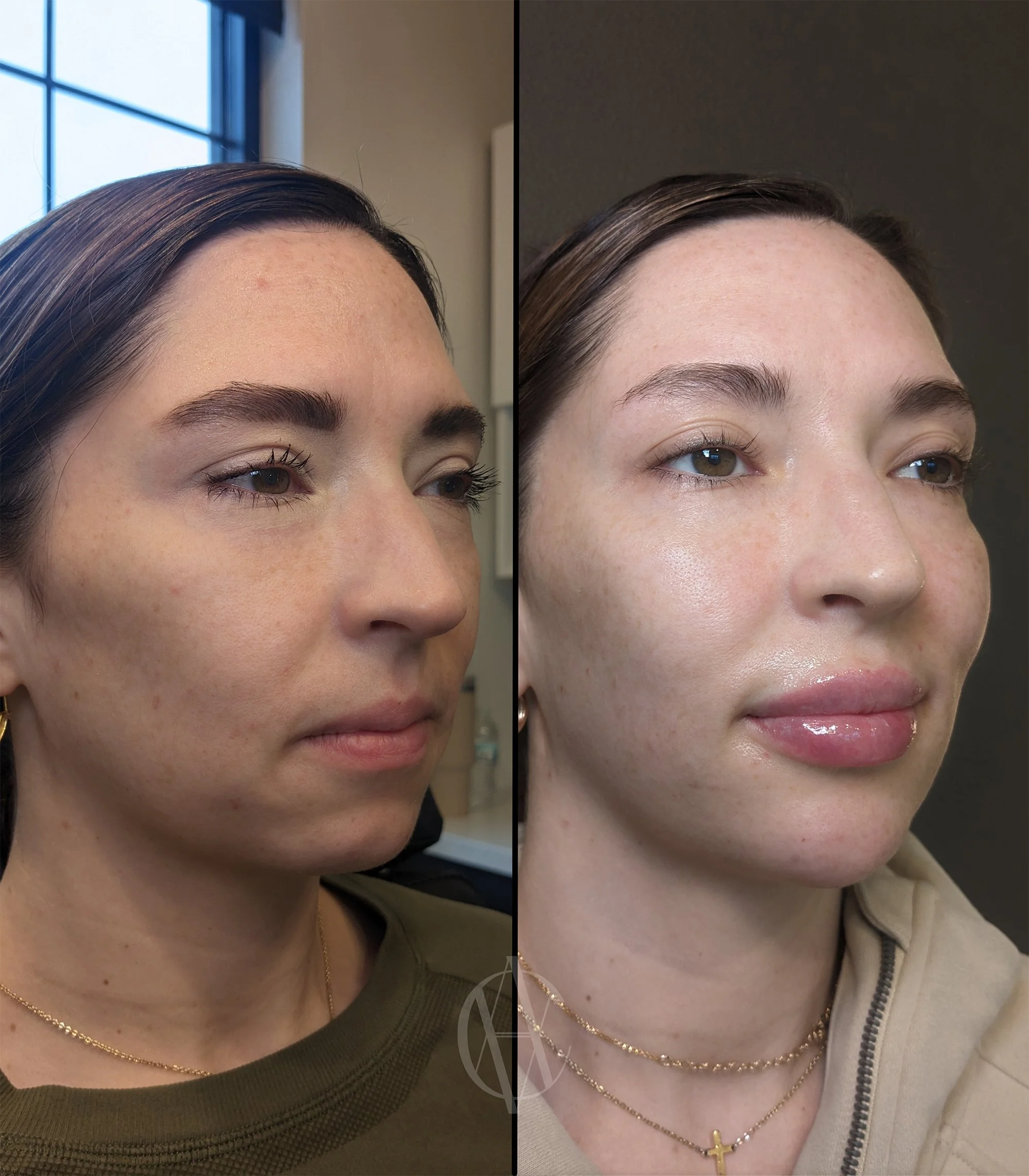
Nothing here was lost — the proportions simply weren't quite balanced. This is the enhancement version of facial balancing, and the plan treated three zones in a single visit precisely because treating one alone would have exposed the other two.
Adding lip volume without chin projection would have pushed the lower third further out of proportion. Together, the three changes read as one change — which is what a balanced result looks like.
Changing the Shape of the Lower Face
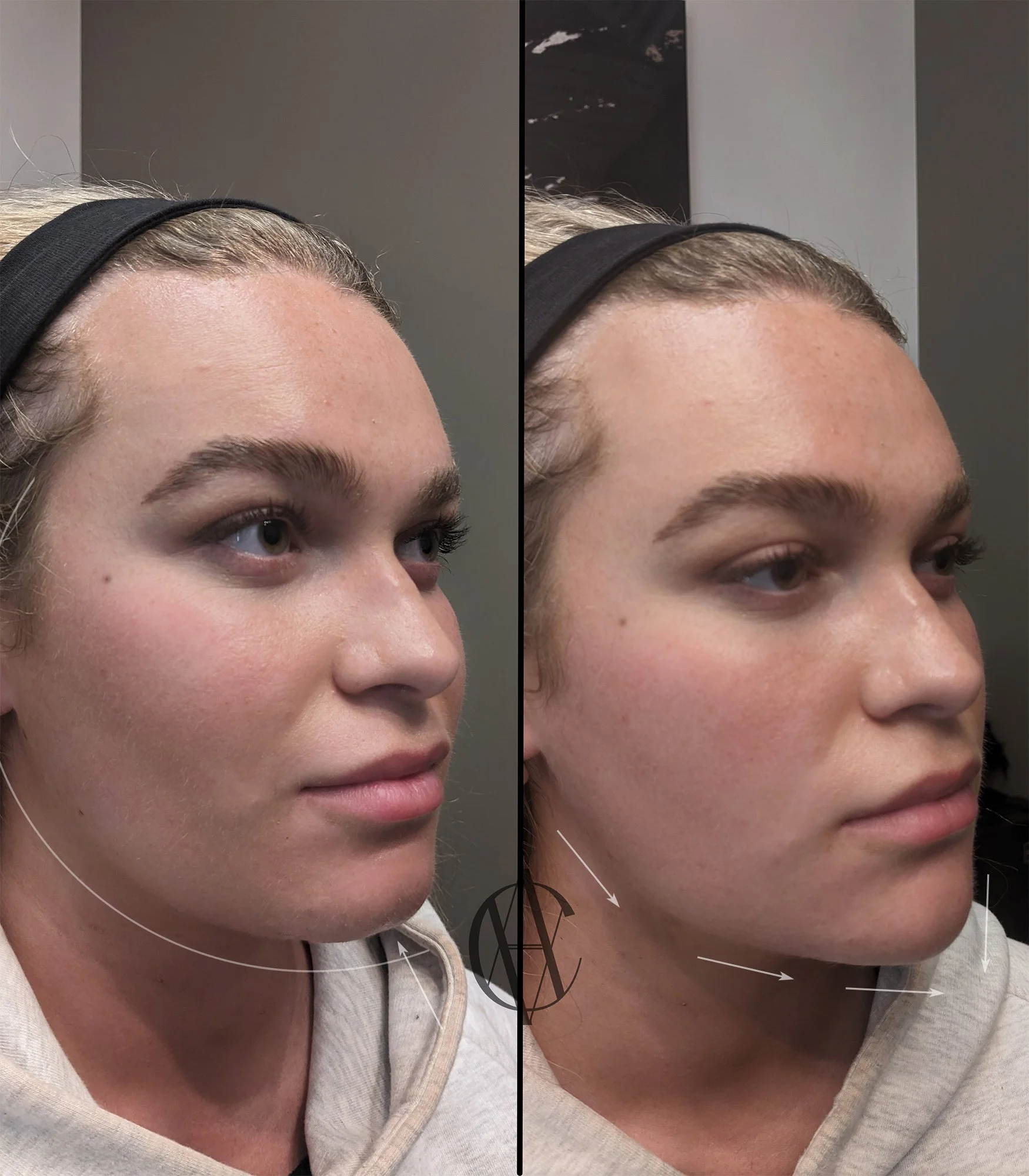
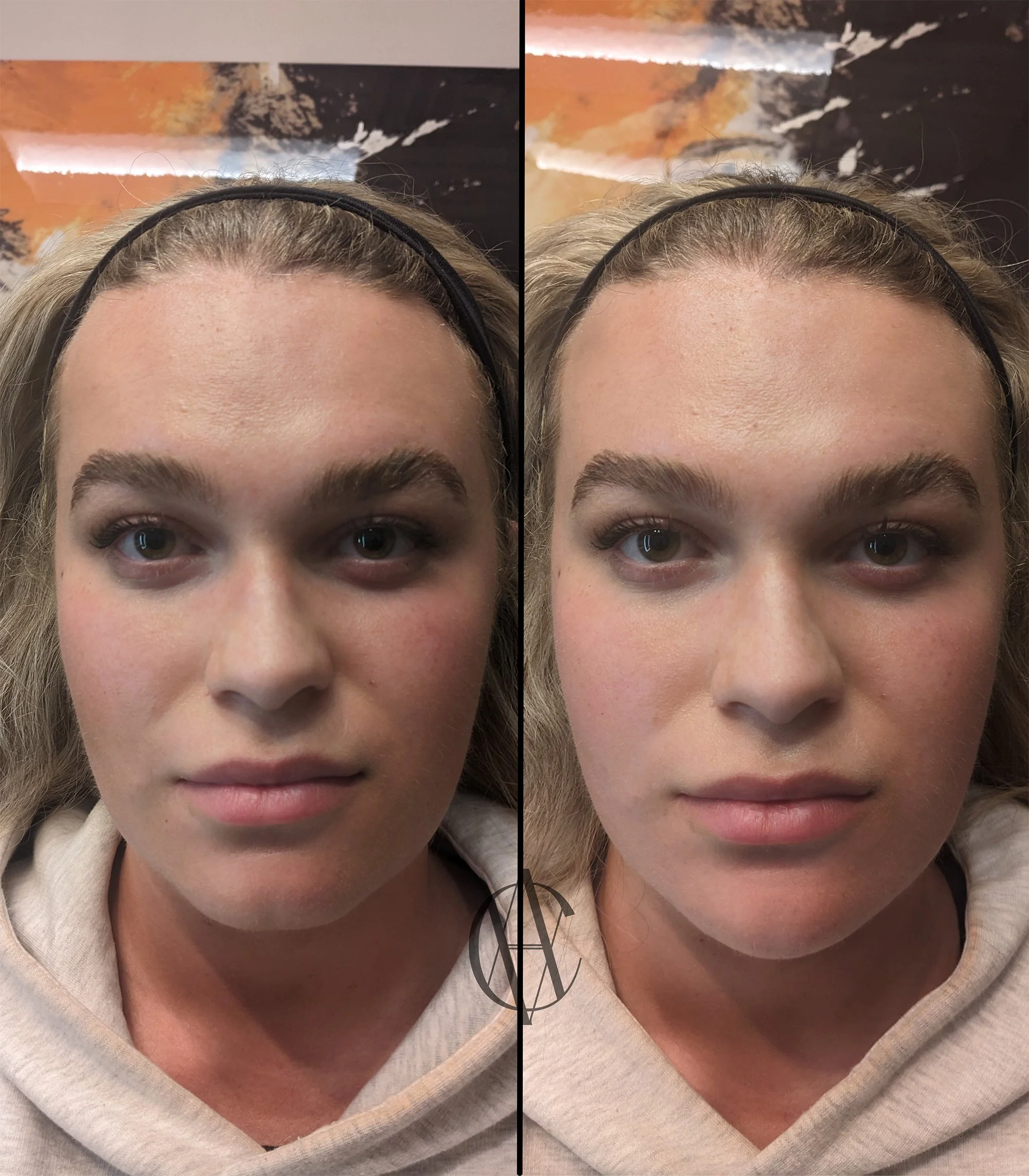
The before shows a softer, rounder jaw angle with minimal chin projection. The arrows mark what changed: definition at the jaw angle, and projection at the chin.
The front view is where the effect is clearest — the face shape shifts from rounder toward heart-shaped, not because anything was removed, but because the lower third finally has structure to define its outline. This is filler used architecturally rather than for volume.
Balance Without Adding Volume
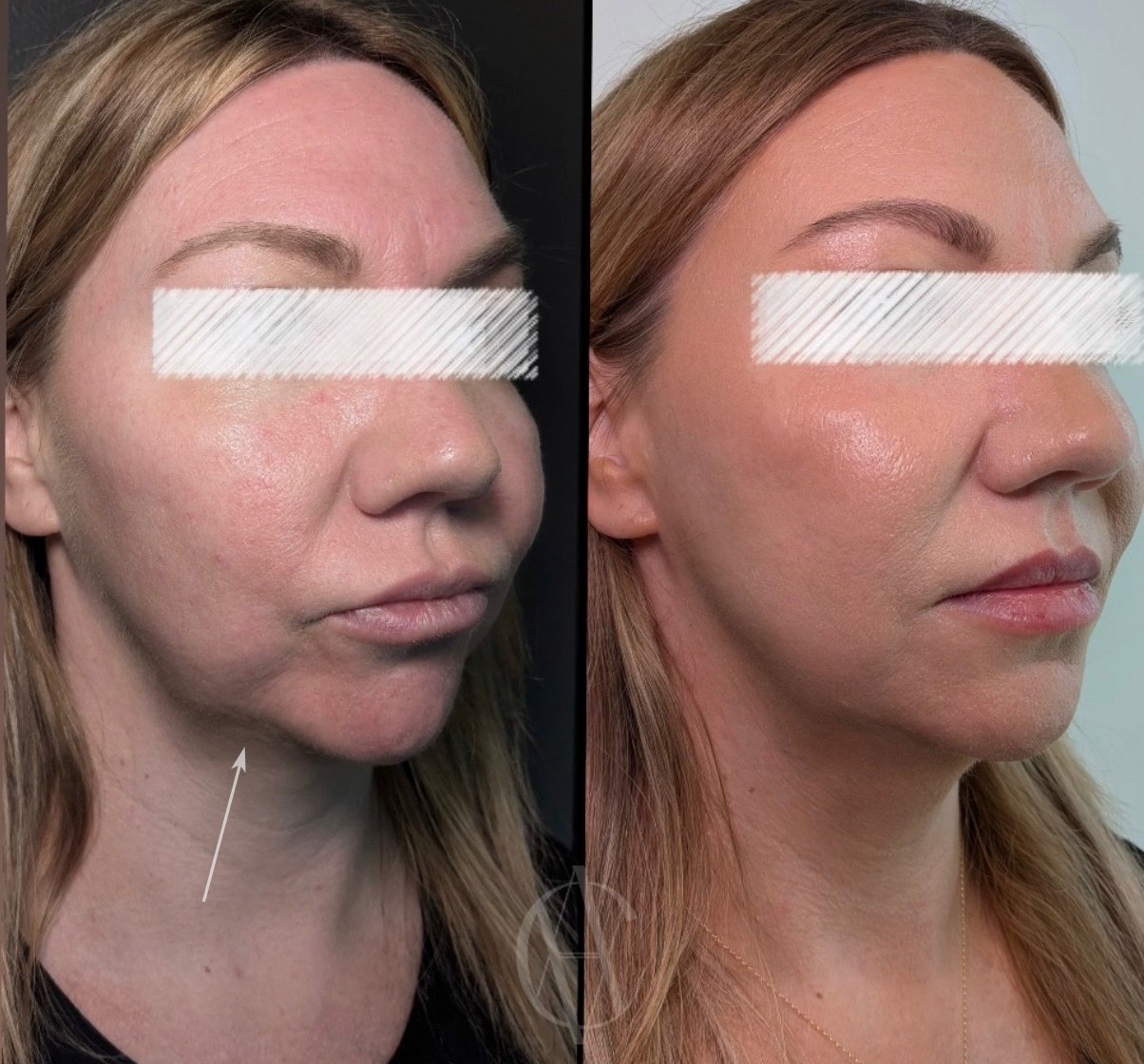
Not every balanced result comes from filler volume. Here, Sculptra rebuilt collagen support through the lower face while a subtle lip enhancement finished the proportion.
Because Sculptra stimulates your own collagen rather than adding volume directly, the change builds gradually over several months rather than appearing overnight — softer jowls, a cleaner jawline, and a smoother marionette line. It's the slowest-moving tool we use and often the most natural-looking.
Individual results vary, and no photo on this page has been retouched, filtered, or altered. Every case names which tool produced which part of the result, because presenting a combined outcome as though one treatment achieved it would set you up for disappointment.
Two honest notes: Sculptra results build over months, not days — those cases represent a full three-session series and the "after" frames are taken well after the final session. And some earlier "before" photos were taken at our previous location, so lighting and background differ between frames in a few sets. We'd rather point that out than have you wonder.
What We Actually Treat Zone by Zone, Tool by Tool
Every zone below has a tool that suits it. Matching the right one to the right problem is most of the job — filler where structure is missing, neurotoxin where muscle is pulling, biostimulator where collagen has thinned.
Upper Third
Mostly muscle — mostly neurotoxinHorizontal lines and the vertical "11s" between the brows. Softened without freezing — dosed in relation to brow position, since over-treating the forehead is what drops a brow. See Botox treatment areas.
The single highest-leverage change in the upper face. A lifted brow tail opens the eye area and reads as rested. Each side is assessed and dosed independently — most brows aren't level to begin with.
Often overlooked, and one of the earliest places volume loss shows. Hollow temples narrow the upper face and make the whole outline read older than the skin does.
Middle Third
Where most balancing plans startThe keystone zone. Restoring support here lifts everything below it — which is why cheek treatment often improves nasolabial folds and marionette lines without touching either directly.
PRF is our preferred approach here — made from your own blood, it improves skin quality and builds support in a delicate area without the puffiness or migration that filler can cause under the eye. Also frequently a midface problem rather than an undereye one, so we assess the cheek first.
The crease from nose to mouth corner. Filling it directly is usually the wrong move — it deepens with midface descent, so rebuilding cheek support addresses the cause instead of the symptom.
Lower Third
Proportion matters more than volumeVolume, shape, and border definition — or a lip flip for more upper lip without filler. Lips read as balanced or unbalanced depending on the chin behind them, which is why we assess both. See lip filler.
The most under-treated area in aesthetics. A chin lacking projection makes a jawline read soft and a profile read recessed. Filler adds structure; neurotoxin relaxes mentalis tension and dimpling. See chin filler.
Definition along the jaw and at the angle. Filler builds outward, masseter neurotoxin narrows inward — opposite tools for opposite problems. See jawline filler and masseter Botox.
The lines from mouth corner downward. Best addressed through a combination — support rebuilt above, the line softened directly, and often DAO relaxation to stop the muscle pulling the corner down.
Where collagen loss shows most plainly. Sculptra rebuilds structural support gradually rather than adding volume — which is why the result reads as firmer rather than fuller. See Sculptra.
Cobblestone texture on the chin from an overactive mentalis, which also pushes the lower lip forward. 4–8 units smooths the surface and releases the whole lower third.
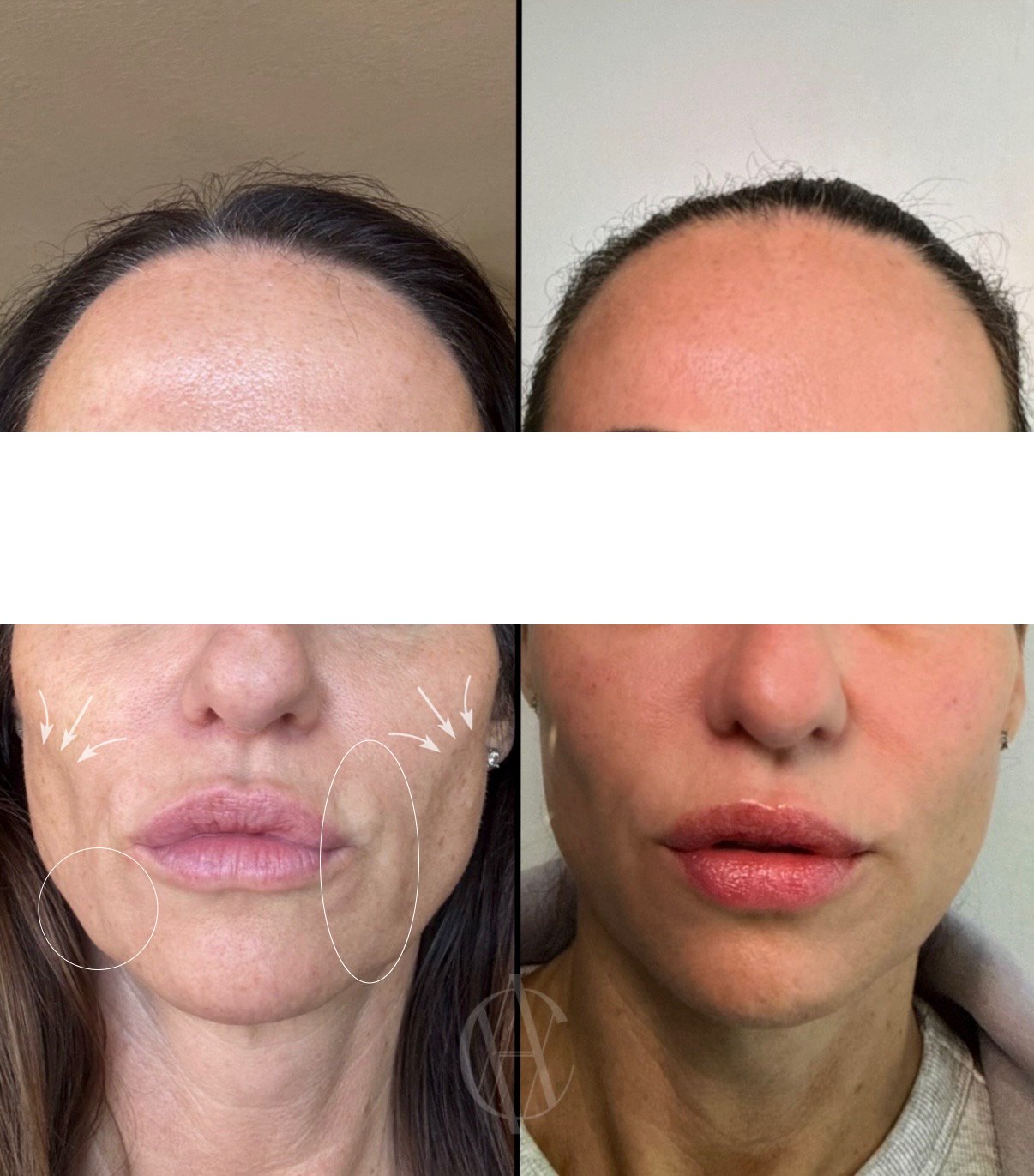
Marked areas show where collagen loss was most visible before treatment: nasolabial folds, marionette lines, and crepey texture along the lower cheeks. Three sessions, two vials each. Individual results vary.
How Collagen Loss Actually Shows Up
Collagen loss rarely announces itself as one thing. It shows up as several small changes at once — folds that didn't used to be there at rest, lines extending down from the mouth corners, and a fine crepey texture across the lower cheeks.
Because they appear together, treating them individually means chasing three symptoms of one cause. Rebuilding the collagen underneath addresses all three at the same time — which is the argument for a biostimulator over filler when laxity, not volume, is the actual problem.
Four Tools, Four Different Jobs And Why the Choice Matters More Than the Brand
These aren't interchangeable. Each one solves a different kind of problem — and using the wrong one on the right area is the most common reason a result looks off rather than natural.
Botox, Dysport, and Daxxify all relax a specific muscle so it stops pulling. Nothing is added — something is released.
That distinction matters for balancing: a downturned mouth or a tense chin isn't a volume problem, it's a muscle working against you. Filling it would be treating the wrong thing entirely. Compare all three on our neurotoxin page.
Hyaluronic acid gel placed where the face needs support or projection. The only tool here that produces an immediate, visible change on the table.
Its real strength in balancing isn't volume — it's architecture. Chin projection, jaw angle definition, midface support. Used well it changes proportion; used poorly it just adds fullness. It's also dissolvable, which no other tool on this list can claim.
A biostimulator that doesn't fill anything. It prompts your own body to rebuild collagen, then dissolves — the result is tissue you made, not product sitting in place.
That's why it reads as firmer rather than fuller, and why it addresses skin quality and laxity that filler can't touch. The tradeoff is patience: a full series, then months of gradual change. More on our Sculptra page.
Platelet-rich fibrin, drawn from your own blood and spun down in-office. Nothing synthetic goes in — the growth factors are yours, and your body uses them to improve the tissue.
This is our preferred approach for the undereye, where filler carries real risk of puffiness and migration in thin, unforgiving skin. PRF works with the tissue instead of sitting under it. See our PRF page.
Rarely One, Rarely All Four
Most balancing plans use two tools, sometimes three — and they're frequently staged rather than done in one visit. Sculptra needs months to show what it's doing, so we often start there and layer filler afterward once we can see what's actually still missing. Placing filler first can mean paying for volume that Sculptra would have produced on its own.
Neurotoxin usually slots in wherever it's needed, since it works independently of the others. PRF sits on its own timeline as a series.
The sequencing is part of the plan, not an afterthought — and it's the main reason facial balancing starts with a consultation rather than a booking for a specific treatment.
What Does Facial Balancing Cost? It Depends — and Here's Exactly Why
There's no single price for facial balancing, because it isn't a treatment — it's a plan. But every component has a real number, and they're all below so you can estimate before you come in.
Any clinic advertising a fixed "facial balancing package" is deciding what you need before they've seen your face. That's the opposite of what this approach is for.
One patient's plan is a single syringe of chin filler. Another's is a Sculptra series staged across six months with neurotoxin layered in. Quoting either number here would mislead the other person — so instead, here's exactly what every component costs, and you'll get a full quote at your consultation before anything is booked.
And it comes back to you. The $50 is credited toward your treatment if you book within 60 days of your consultation — so for anyone who moves forward, the assessment effectively costs nothing.
If you're already booked for a specific treatment, assessment is included in that appointment at no extra charge. The standalone consultation is for people who want the full plan first.
One syringe of filler is roughly the size of a blueberry. That's almost always smaller than people picture, and it's why a single syringe rarely transforms a whole zone. Most areas need one syringe per side — though for a small deficit or a touch-up, half a syringe per side means one syringe covers both. We'll tell you which applies to you rather than defaulting to more.
Roughly One Vial Per Decade of Age
Sculptra isn't priced by area — it's priced by vial, and the number of vials tracks how much collagen has been lost. The rule of thumb is about one vial for every ten years of age, adjusted to what we actually find at your assessment.
The reassessment matters. Plenty of patients finish at four vials because that's all they needed — we'd rather stop there than complete a number quoted before we'd seen how you responded. Maintenance afterward is modest: roughly one vial every 18–24 months in your 30s–40s, one to two vials yearly through your 40s–50s, and two to three yearly from 60 on.
$100 Off Every Full Syringe When You Treat More Than One Area
Because balancing usually means treating two or three zones together, we discount $100 per full syringe when more than one area is treated in a plan — and $50 on a half syringe. It's the opposite of a package upsell: the discount exists because a multi-zone plan is the clinically better approach, not because we want you buying more.
Under Eyes: Filler Is Rarely the Answer
This is the area patients most often ask for filler in, and the area where filler is least often the right choice. What we actually assess:
In your own words — you don't need to know the terminology or arrive with a treatment in mind. "I look tired," "my face looks heavier than it used to," and "I don't like my profile" are all perfectly workable starting points.
Structure, volume, muscle activity, and skin quality — across all three thirds, at rest and in movement. This is where we identify whether what's bothering you originates where you think it does. Frequently it doesn't.
Anyone can list ten things that could be treated. The useful part is knowing which two would make the biggest difference — and which can wait, or be skipped entirely. You'll get that ranking, honestly.
A plan with an order and a timeline — what to do first, what to reassess later, and what it costs at each stage. Staging isn't a sales tactic; it's how you avoid paying for volume that a biostimulator would have built on its own.
Take the plan home and think about it. Start with one piece. Or decide it isn't for you. There's no obligation to book anything on the day, and plenty of patients leave with a plan they act on months later.
Balancing plans are frequently the largest single investment patients make with us, and Cherry offers payment plans with 0% APR options across everything we offer. It also pairs naturally with a staged plan — spreading cost across the months the treatment is actually happening. Apply in minutes with no impact to your credit score.
Explore FinancingNot sure whether you need a full plan or a single treatment? That's exactly what the consultation answers — and often the answer is less than people expect.
Facial Balancing FAQ New Berlin & Milwaukee, WI
Facial balancing is an approach rather than a treatment. Instead of treating one feature in isolation, we assess how the whole face relates to itself — how the midface sits above the jaw, how the chin relates to the lips, whether the lower third is proportional to the upper.
Then we identify which relationship is actually driving what's bothering you and treat that, using whichever tool suits it: neurotoxin, filler, a biostimulator like Sculptra, or PRF. Often the answer is upstream of where you were looking — cheek support for a marionette line, chin projection for a soft-looking jawline.
There's no single price, because it depends entirely on your plan. One patient's is a single syringe of chin filler at $850. Another's is a Sculptra series plus filler staged across six months.
Every component has a real number: filler from $850 per syringe ($750 for under eye), Sculptra at $850 per vial, PRF at $600 per session, and neurotoxin at $11–$13 per unit. And when more than one area is treated, $100 comes off every full syringe. You'll have a full quote at your consultation before anything is booked.
A standalone consultation is $50 — and it's credited toward your treatment if you book within 60 days. So for anyone who moves forward, the assessment effectively costs nothing.
If you're already booked for a specific treatment, assessment is included in that appointment at no extra charge. The standalone consultation is for people who want the full plan before committing to anything — and there's no obligation to book on the day.
No. Plenty of patients leave a consultation with one recommendation and a note that the rest doesn't need touching. Facial balancing isn't a package — it's a way of deciding what to treat, which sometimes means treating less than you expected.
That said, treating two or three zones together often produces a better result than treating one, because the zones affect each other. When that's the case we'll explain why — and the multi-area discount exists because it's the clinically better approach, not because we want you buying more.
Probably not — and this is the treatment most often asked for where filler is least often right. What we assess:
Genuine hollowing is the one case where we'll place filler directly under the eye. Dark circles respond far better to PRF — filler does nothing for pigment. Puffiness or prominent fat pads makes you a surgical candidate, not a filler candidate; adding volume there makes it worse. Skin laxity and crepiness need a multi-modality approach — microneedling, medical-grade skincare, and PRF.
And most commonly: you need cheek filler, not under eye filler. When midface support is rebuilt, the hollow above it softens on its own. That's why the cheek is the first thing we assess for any undereye concern.
They solve different problems. Filler adds structure where structure is missing — chin projection, jaw definition, midface support. It works immediately and it's dissolvable. Sculptra rebuilds your own collagen, so it addresses laxity and skin quality that filler can't touch. It reads as firmer rather than fuller.
Sequencing matters here: placing filler first can mean paying for volume that Sculptra would have produced on its own. When both are in a plan, we often start with Sculptra and layer filler afterward once we can see what's genuinely still missing. See our Sculptra page for detail.
The rule of thumb is roughly one vial per decade of age — 1–2 vials in your 20s, 2–3 in your 30s, 3–5 in your 40s, 4–6 in your 50s, and 5–7 from 60 on. At $850 per vial, that's the main driver of cost.
The series is spaced: two vials, wait 6–8 weeks, two more, wait again, then reassess. Plenty of patients finish at four because that's all they needed — we'd rather stop there than complete a number quoted before seeing how you responded. Maintenance afterward is modest: about one vial every 18–24 months in your 30s–40s.
It depends on the tools in your plan. Filler is immediate — visible on the table, settled within two weeks. Neurotoxin reaches full effect at day 14. Sculptra and PRF build gradually over months, because they're prompting your body to make the change rather than making it directly.
A staged plan involving Sculptra typically spans four to six months from first appointment to final result. That's not a delay — it's how the tool works, and it's why we sequence rather than doing everything at once.
Neurotoxin: 3–4 months, or 5–6 with Daxxify. Filler: 6–18 months depending on the product and area — structural filler in the chin and jaw generally outlasts lip filler. Sculptra: the collagen it builds is your own tissue, so results hold roughly two years with modest maintenance.
Because the components last different lengths of time, maintenance ends up staggered rather than requiring one big appointment each year — which most patients find easier to manage financially.
The overdone look almost always comes from volume added without regard to proportion — lips filled past what the chin behind them supports, cheeks built beyond what the face structure holds. It's a planning failure, not an inevitable outcome of filler.
Balancing is the direct antidote to that, because proportion is the whole basis of the assessment. And worth knowing: one syringe is roughly the size of a blueberry — considerably less than most people picture. Results that look obvious usually involved far more product than a balanced plan calls for.
Yes — hyaluronic acid filler is dissolvable, and that's a genuine advantage it has over every other tool on this page. If a result isn't what you wanted, it can be reversed rather than waited out.
For completeness: Sculptra cannot be dissolved — it stimulates your own collagen, so there's nothing to remove. That's a reason to be conservative with vial count and to reassess mid-series rather than committing to a large number upfront, which is exactly how we structure it. Neurotoxin and PRF both simply wear off.
It can be — and frequently is. Where it's used to mean "a package of treatments we'd like to sell you," it's marketing. Any clinic advertising a fixed-price facial balancing package is deciding what you need before seeing your face.
Where it's meaningful is as a method of assessment: looking at the whole structure, identifying which relationship is driving the concern, and treating that rather than the symptom. The honest test is simple — if the recommendation is always "more areas," it's marketing. If it sometimes comes back as "one thing, and skip the rest," it isn't.
Sometimes, and sometimes it shouldn't be. Filler across multiple zones plus neurotoxin can absolutely be done in one visit — that's what most of the results on this page represent.
But Sculptra needs to be staged, both because the series is spaced 6–8 weeks apart and because layering filler on top before you can see what the collagen has built risks paying twice for the same volume. Staging isn't us spreading out revenue — it's how you avoid over-treating.
All injectable treatments are performed by Registered Nurses only — Natasa (Founder & RN) or Christy (Lead RN) — under the medical oversight of Dr. Dave Christianson, Medical Director.
Assessment experience matters more here than in any single-treatment appointment, because the value is in the judgment about what to treat. We're located at 15155 W National Ave in New Berlin, WI — about 8 minutes from Brookfield, 12 from Waukesha, and 22 from Milwaukee.
Natasa and Christy are happy to talk it through before you commit to anything.
Call (414) 265-6586, or book the consultation and take the plan home.
What It Looks Like in Real Life Not in a Clinical Photo
Every before-and-after on this page was shot in controlled light against a neutral background — which is how you compare results honestly. But it isn't how anyone actually sees you.

Healed result, photographed by the patient in everyday light. Lip filler as part of a facial balancing plan. Individual results vary.
The Test That Actually Matters
This is the same treatment, weeks later, in ordinary light — taken by the patient rather than by us. No standardized angle, no studio lighting, no clinical framing.
We include it because it answers the question a before-and-after can't: does the result still read as natural when nobody is controlling the conditions? A result that only holds up in a clinical photo isn't a result worth having.
It also shows what settled filler looks like. Everything looks slightly full at two weeks — the honest picture is the one taken after it's integrated, when it stops looking like a treatment and starts looking like a face.
What Patients Say Google Reviews — A-Class Aesthetics
Facial Balancing Near You Serving SE Wisconsin
A-Class Aesthetics is located at 15155 W National Ave in New Berlin, WI — directly across from the New Berlin Public Library. We're a short drive from Milwaukee, Waukesha, Brookfield, Pewaukee, Menomonee Falls, Elm Grove, Greenfield, and West Allis. Whether you're searching for facial balancing near Milwaukee, filler and Sculptra in Waukesha, or a full-face consultation in Brookfield, our New Berlin location is easily accessible from across SE Wisconsin — with free parking and unhurried consultation appointments.
New Berlin, WI 53151

Start With the Assessment Not With a Treatment
$50, credited toward treatment if you book within 60 days. You'll leave with a prioritized plan, a full quote, and no obligation to act on any of it — including the option that it's less than you expected. Minutes from Milwaukee, Waukesha, and Brookfield.